Main problem
Risks live in Excel, but not in daily work
Many risk lists are maintained for audits, but not used when decisions are made, actions are planned or processes are improved.

qmBase Risk Management
qmBase connects risks and opportunities with actions, responsibilities and the context of your management system. Risk management becomes operational control instead of just audit evidence.
Daily challenge
Risk management rarely fails because of missing spreadsheets. It fails when risks are not connected with actions, responsibilities and decisions.
Main problem
Many risk lists are maintained for audits, but not used when decisions are made, actions are planned or processes are improved.
Different scales, inconsistent categories and manual calculations make priorities unclear.
When responsibilities, tasks and effectiveness checks are not visible directly on the risk, control gaps appear.
How the app works
The app makes visible which risks are critical, who is responsible and which actions result from them.
Capture
Manage risks and opportunities centrally
One shared place for risk descriptions, categories and context
Assess
Use your own assessment models
Probability, impact, detection or your own factors
Prioritize
Recognize critical risks faster
Clear risk priority instead of unclear list maintenance
Control
Connect actions directly
Tasks, CAPA, projects and improvements stay connected
Own
Make responsibilities visible
Every risk has owners and monitoring logic
Monitor
Evaluate status and due dates
Dashboards show open assessments and overdue actions
No risk without context
In qmBase, a risk is not alone in a list. It is connected with actions, audits, processes, products and objectives.
Context is what makes risks truly traceable for employees and auditors.
Responsibilities, assessments and actions work directly together.
Risk

qmBase Story 04
"One more beer?"
"Gladly."
"And what about the audit on Monday?"
"Everything has been ready for ages."
Less audit stress. More weekend.
Numbers become actions
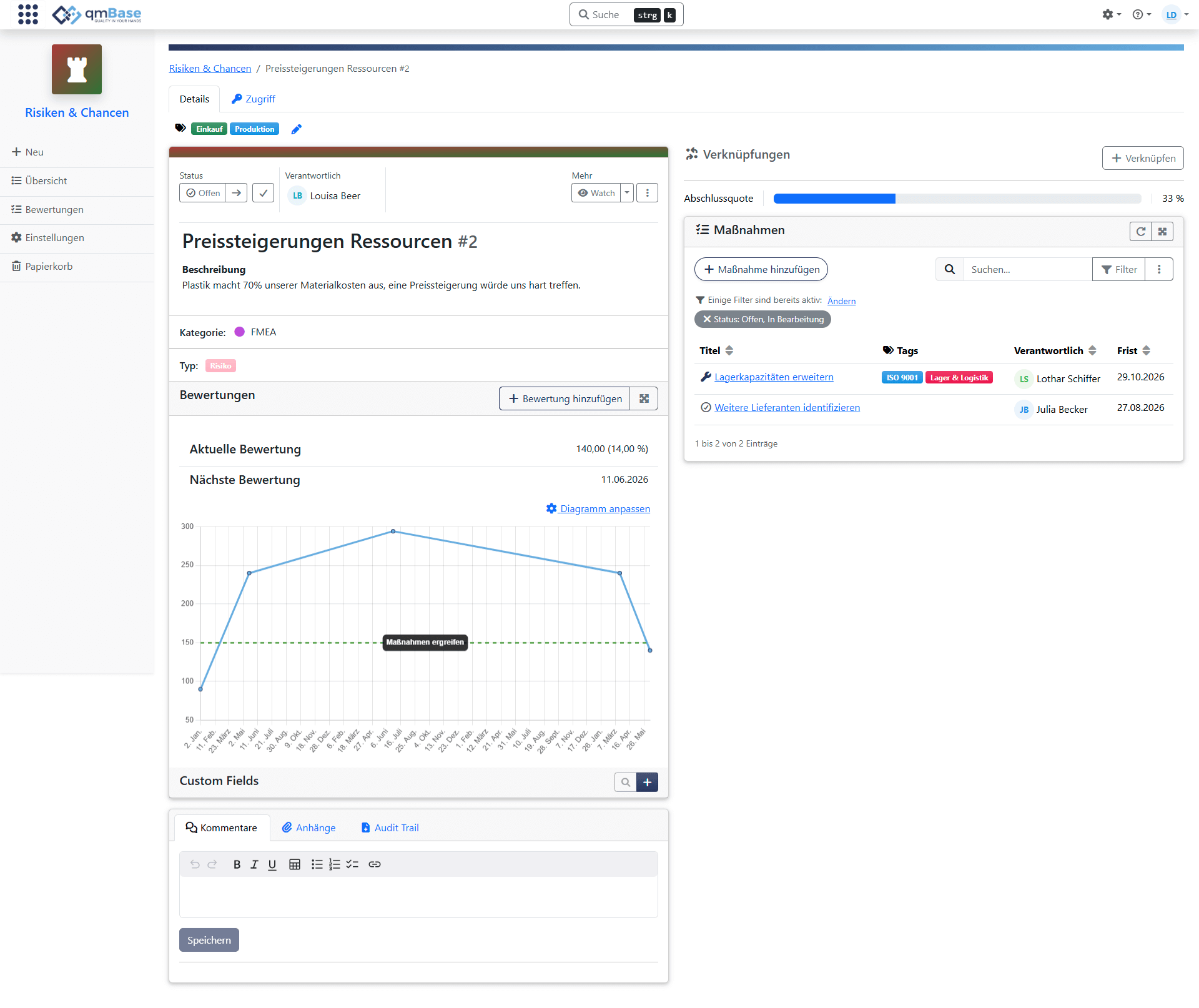
qmBase maps risk assessments through thresholds, development over time, actions and reassessment. This creates operational control instead of an isolated matrix.
qmBase shows when an assessment exceeds a defined threshold and operational actions become necessary.
The development of a risk assessment stays visible over time, including threshold and next review.
Current assessment
120.0012.00%
Next assessment
May 26, 2027
Assessment history
Actions reduce the assessment value, while reassessment keeps the risk controllable.
Thresholds create a clear basis for traceable and consistent decisions.
Deep dive: actions
Risks do not remain theoretical. qmBase guides you from assessment to a connected task, CAPA or improvement action.
Every risk has clear owners, due dates and a status.
Tasks, CAPA or projects are not loose items next to the risk. They are directly connected with it.
Risk control
An assessment becomes a controllable action
Supplier delay for critical component
Category
Supply chain
Owner
M. Schneider
Source
Audit / claim
Probability
4 / 5
Impact
5 / 5
Priority
highAction
Qualify second supplier
Due date
Jun 30, 2026
Reassessment
after effectiveness check
Risks in company context
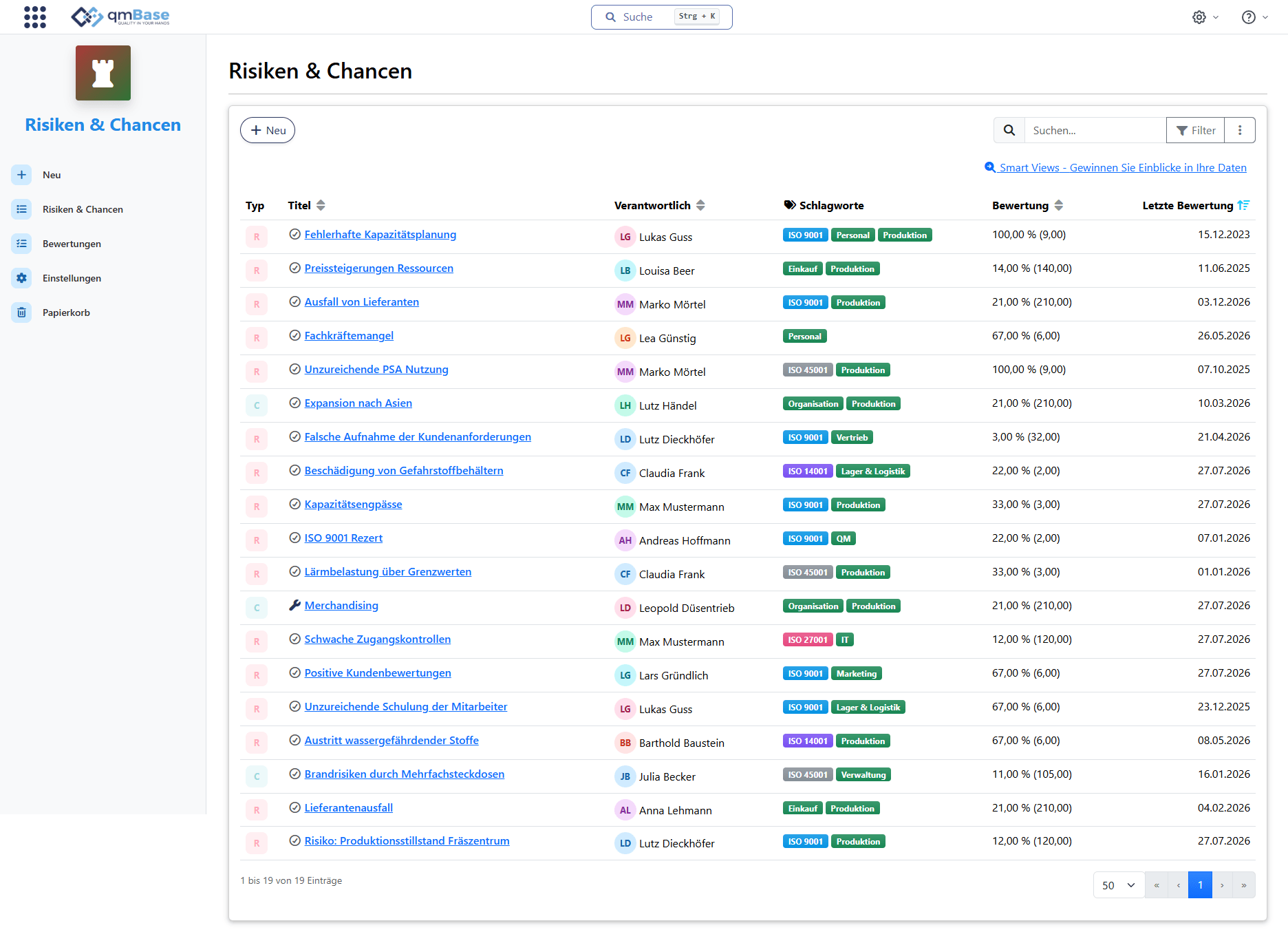
Risks and opportunities are not managed in isolation, but structured by context, responsibility and assessment.
Tags show whether a risk comes from production, purchasing, ISO clauses, HR or an environmental context.
Review dates and responsibilities prevent risks from being forgotten.
One list, multiple professional perspectives
Owner
Tags
Rating
120
LastDec 3, 2026
NextDec 3, 2027
Owner
Tags
Rating
100
LastOct 7, 2025
NextJun 18, 2025
Owner
Tags
Rating
95
LastFeb 12, 2026
NextFeb 12, 2027
More control in the management system
“The different modules cover all ISO 9001 requirements. The software is clearly structured, easy for everyone to understand and can therefore be used well across the entire company.”
Marvin Pries
Quality management·D.C. Industrie Elektronik GmbH
See in a demo how qmBase connects risks, opportunities, actions and responsibilities into one networked management system.